

UAV operations are moving beyond manual launches, distant pilots, and isolated field tests. A reliable Uav Station can charge, shelter, inspect, and redeploy an aircraft with limited human intervention. For global buyers, this shift changes the purchasing question. The best manufacturer is not always the one offering the lowest hardware price.
Michael Huerta, former Administrator of the U.S. Federal Aviation Administration, stated, “The skies of the future will be filled with drones.” His observation remains relevant as enterprises adopt autonomous aerial systems for utilities, public safety, agriculture, logistics, and industrial inspection. Yet a drone cannot deliver dependable value without a station designed for its environment.
This guide examines leading UAV station manufacturers through practical buying criteria. These include weather resistance, battery management, remote operations, aircraft compatibility, software integration, maintenance access, and regulatory readiness. Buyers should also examine deployment evidence, service networks, cybersecurity practices, and replacement-part availability. A polished demonstration means little if the station fails after dust, rain, heat, or repeated charging cycles.
Field experience matters.
Some manufacturers excel at compact systems. Others focus on heavy-duty infrastructure, thermal inspection, or fleet coordination. Their strengths are not identical. That difference deserves careful attention.
No ranking can fit every market perfectly. Local airspace rules, connectivity gaps, climate conditions, and labor costs may change the final decision. A station built for a European utility corridor may struggle on a remote tropical site. This overview therefore offers a useful starting point, not a substitute for technical validation, pilot deployment, and honest supplier discussions.
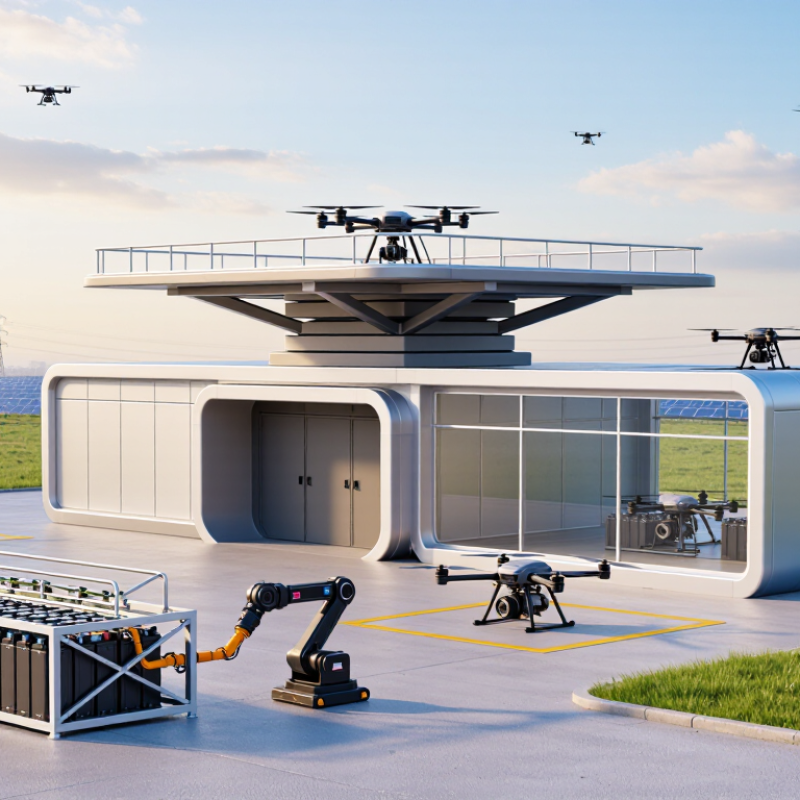
A UAV station is a fixed or mobile facility that supports unmanned aircraft between missions. It may provide automated landing, battery charging, data transfer, weather sensing, and secure communications. In practical deployments, the station acts like a sheltered service bay. It reduces manual handling and allows operators to supervise flights from a distance.
MarketsandMarkets reported that the global drone market could reach about USD 58.4 billion by 2026, driven by commercial and public-sector adoption. This growth increases demand for reliable station infrastructure, not only aircraft. Core functions include precision landing, battery-health monitoring, payload protection, and cloud-connected mission scheduling. The system should also record maintenance events and connection failures. Small details matter. A blocked landing sensor can stop an entire inspection route.
Commercial applications are expanding across power-line inspection, construction surveys, precision agriculture, environmental monitoring, and emergency mapping. The World Economic Forum has identified drones as important tools for infrastructure and industrial productivity. Still, automated operations are not automatically dependable. Weather limits, weak network coverage, inaccurate maps, and unsuitable battery temperatures can reduce performance. That assumption deserves scrutiny. Global buyers should examine station testing records, operating ranges, cybersecurity controls, maintenance access, and compliance documentation. Manufacturers with transparent performance data are easier to evaluate, especially when a station must operate daily at a remote site. The best specification is not always the most ambitious one. It is the one that remains reliable after repeated landings, dust exposure, and imperfect human decisions.
Selecting a UAV station manufacturer requires more than comparing flight range or camera resolution. A 2024 Drone Industry Insights report projects the global drone market could reach 54.6 billion dollars by 2030. That growth increases pressure on manufacturers to deliver dependable systems, not attractive prototypes. Buyers should examine automated landing accuracy, charging cycles, weather protection, and maintenance access. A station exposed to rain, dust, and heat needs tested ingress protection, not vague marketing language.
Operational evidence matters. Ask for logged performance data from comparable environments, including failed landings, battery degradation, and recovery procedures. The FAA’s 2024 Aerospace Forecast records more than 850,000 registered drones in the United States, showing how quickly operational scale is expanding. Manufacturers should explain remote identification, data encryption, software updates, and airspace integration in clear technical terms. Independent testing is stronger evidence than a polished demonstration.
Security deserves equal attention. Review access controls, audit logs, supply-chain practices, and the location of cloud servers. Request service-level targets for replacement parts and technical response times. Small details matter. A blocked drainage channel or weak cellular fallback can stop a station during a critical inspection. I would not treat every published uptime figure as comparable; testing conditions often differ. The more reliable supplier shares limitations, raw test methods, and corrective actions without defensiveness.
Top UAV Station Manufacturers for Global Buyers
Leading UAV Station Manufacturers in the Global Market
The global UAV station market is expanding with demand for remote inspection, mapping, and emergency monitoring. Fortune Business Insights valued the commercial drone market at about USD 20.98 billion in 2023. Its forecast indicates continued double-digit growth through 2032. This expansion is pushing UAV station manufacturers to improve automation, weather resistance, and remote fleet control.
Reliable manufacturers now design stations with sealed charging systems, thermal management, and accurate landing guidance. A station placed beside a wind turbine may face dust, rain, and unstable network coverage. Therefore, buyers should examine IP protection, operating temperature, battery replacement time, and communication redundancy. Small details matter. A two-minute recovery delay can interrupt a scheduled inspection.
Drone Industry Insights has repeatedly identified infrastructure, software, and services as major value areas in commercial drone operations. Manufacturers serving global buyers should provide documented test results, cybersecurity controls, and regional maintenance support. They should also explain how their systems integrate with existing flight-management platforms. However, published specifications are not always field-proven. Buyers need pilot projects, service records, and transparent failure data before large deployment. A lower purchase price may hide expensive installation or repair requirements.
| Supplier Profile | Primary UAV Station Category | Typical UAV Compatibility | Control-Link Options | Typical Operating Temperature | Common Protection Rating | Portability Level | Typical Global Application |
|---|---|---|---|---|---|---|---|
| Profile A | Portable ground control station | Multirotor and small fixed-wing UAVs | 2.4 GHz, 5.8 GHz, private radio, LTE/5G | -20°C to +55°C | IP54–IP65 | Backpack or rugged carry case | Infrastructure inspection, surveying, public safety |
| Profile B | Vehicle-mounted command station | Medium multirotor and fixed-wing UAVs | Encrypted radio, microwave link, LTE/5G, satellite backhaul | -30°C to +55°C | IP54–IP66 | Integrated vehicle console | Emergency response, border monitoring, utility operations |
| Profile C | Containerized remote operations station | Medium- and large-class UAV systems | Long-range radio, fiber, cellular, satellite communications | -30°C to +50°C | IP55–IP66 | Fixed or semi-permanent deployment | Industrial security, coastal surveillance, critical infrastructure |
| Profile D | Industrial ruggedized control station | Industrial multirotor, VTOL and fixed-wing UAVs | Private LTE/5G, dual-band radio, Ethernet, fiber | -40°C to +60°C | IP65–IP67 | Rugged transport case or rack-mounted | Mining, energy, construction, remote asset management |
| Profile E | Maritime UAV command station | Marine-capable multirotor and fixed-wing UAVs | Marine radio, cellular, satellite, long-range data link | -20°C to +55°C | IP65–IP67 | Shipboard or portable marine enclosure | Offshore inspection, maritime patrol, port security |
| Profile F | High-performance mission control station | Long-endurance fixed-wing and VTOL UAVs | Beyond-visual-line-of-sight radio, satellite, fiber, cellular | -30°C to +50°C | IP54–IP65 | Dedicated operations room or mobile shelter | Large-area mapping, environmental monitoring, defense support |
| Profile G | Cloud-connected UAV operations station | Commercial multirotor and VTOL platforms | LTE/5G, Wi-Fi, Ethernet, cloud command interface | 0°C to +45°C | IP20–IP54 | Office, control room or compact field kit | Fleet management, agriculture, logistics, inspection services |
| Profile H | Modular public-sector command station | Mixed fleets from small multirotors to VTOL UAVs | Interoperable radio, LTE/5G, Ethernet, satellite gateway | -20°C to +55°C | IP54–IP65 | Portable, vehicle-mounted or fixed configuration | Search and rescue, disaster management, law enforcement |
Top UAV Station Manufacturers for Global Buyers
Comparing UAV station technologies begins with the operating environment. A station for coastal inspection needs different protection than one used on dry farmland. Look for weather sealing, temperature tolerance, dust resistance, and stable communications. Automatic landing can reduce workload, but it still depends on accurate positioning and clear site planning. Some systems support battery swapping, charging cabinets, and multiple aircraft. Others offer only basic shelter and power control. That difference affects daily productivity.
Services often reveal more than the equipment sheet. Experienced manufacturers should provide installation guidance, operator training, software updates, and responsive technical support. Ask how quickly replacement parts can arrive in your region. Also check whether the system integrates with existing mapping, fleet management, and safety tools. A trial deployment can expose weak network coverage, awkward maintenance access, or confusing alerts. These details are easy to miss during a polished demonstration.
Pricing requires a wider view. The purchase quote may exclude civil works, antennas, connectivity, training, and annual software fees. A lower initial price can become expensive after repeated service visits. Conversely, premium hardware may be wasteful for simple, low-frequency missions. Compare five-year ownership costs, not only the invoice. Request realistic performance data from similar climates and workloads. Marketing claims deserve verification. I would also keep a contingency budget, because field conditions rarely match the proposal perfectly. Repair times and local support may matter more than a few advanced features.
Global buyers should evaluate UAV station suppliers against operating evidence, not polished demonstrations. MarketsandMarkets estimated the global UAV market at USD 30.6 billion in 2024, with strong growth expected through 2029. That expansion increases supplier choices, but also increases quality differences. Request flight logs, maintenance records, battery-cycle data, and documented recovery procedures. A reliable supplier should explain how the station performs during rain, dust, heat, and weak network coverage.
Weather changes quickly. Check the enclosure’s IEC 60529 IP rating, tested temperature range, wind limits, and charging behavior. Ask whether the station supports independent power backup and automatic fault alerts. For communications, test cellular, satellite, and local-network options at the actual site. A supplier’s integration plan should cover the aircraft, control software, access control, data storage, and existing security systems. Generic compatibility claims are not enough.
The FAA’s Aerospace Forecast identifies continued growth in commercial drone operations, making service capacity a practical selection factor. Confirm spare-part locations, technician response times, software update policies, and training arrangements in your region. Cybersecurity evidence should include access logs, encryption practices, vulnerability handling, and clear data ownership terms. Tests fail. That is useful. A serious supplier should show how failures are detected, recorded, and corrected. Cost comparisons should include installation, permits, connectivity, inspections, and five-year maintenance. The cheapest quotation may become the least predictable investment.

