How to Choose the Right Galvanized Nails for Your Project?
Choosing the right galvanized nails can be a challenge. Industry expert Sarah Thompson once said, "The right nail can transform your project." Understanding the various types of galvanized nails is crucial for successful outcomes.
Galvanized nails are crucial for outdoor projects. They resist rust and corrosion. This durability makes them a popular choice among builders. However, not all galvanized nails are the same. Variations exist in size, coating, and intended use.
Some nails might not hold well in certain materials. Others may not be sufficient for heavy-duty tasks. Knowing these details can prevent frustration later. Choosing the wrong galvanized nails may lead to a failed project. It's essential to consider specific requirements before making a decision.
Understanding the Different Types of Galvanized Nails and Their Uses
When selecting galvanized nails, it’s essential to understand their types and uses. There are mainly three categories: hot-dipped, electro-galvanized, and mechanical galvanizing. Hot-dipped nails have a thicker zinc coating. They offer excellent corrosion resistance. Use them for outdoor projects, especially in direct contact with moisture.
Electro-galvanized nails, on the other hand, have a thinner coating. They are less expensive but also less durable. These nails work well for indoor applications where rust exposure is minimal. If you choose the wrong type, you may face problems later.
Consider your project environment. Think about factors like humidity and contact with soil. Sometimes, people overlook these details and end up with rusted nails. In contrast, mechanical galvanizing provides a uniform finish.
It may not be the best choice for every scenario. Reflect on your specific needs before deciding. Choosing the right nail can make a significant difference in your project’s lifespan.
Factors to Consider When Selecting Galvanized Nails for Specific Materials
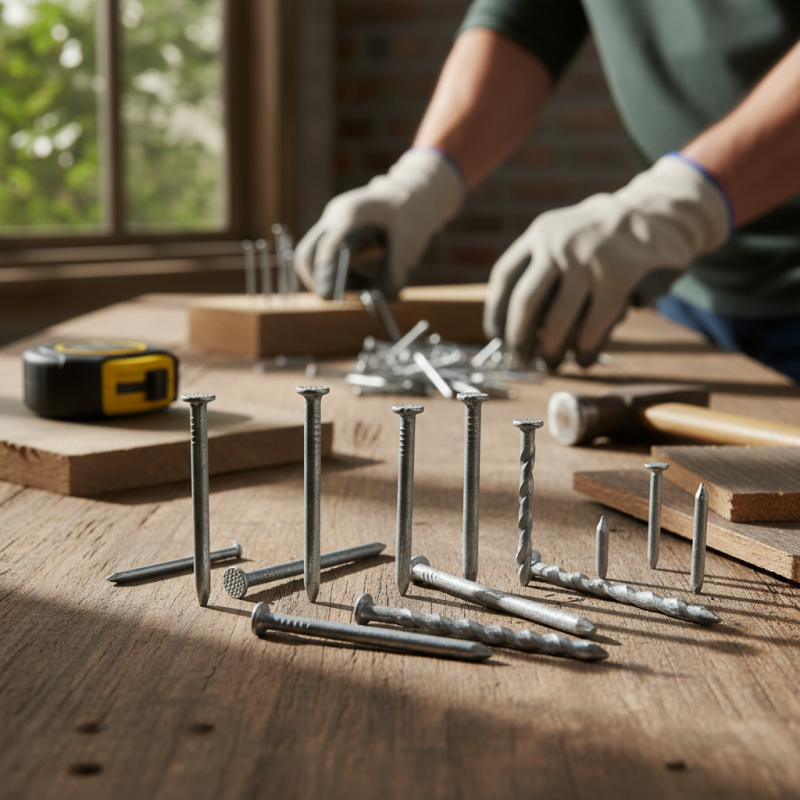
When selecting galvanized nails, the material you are working with is crucial. Different materials require specific types of nails for optimal performance. For instance, when attaching wood to wood, a spiral or ring shank nail may provide the extra grip needed. Each type also has its own coating thickness, which impacts corrosion resistance. This is particularly important for outdoor projects.
Consider the thickness of the materials as well. Thicker wood might need heavier gauge nails to ensure secure fastening. In contrast, thinner sheets could require lighter nails to avoid splitting. It’s essential to match the nail size to the thickness and density of the materials you use. Testing a few nails before full implementation could save time and prevent costly mistakes.
Tips: Always keep an eye on the environment where the nails will be used. If humidity or moisture is a concern, choose nails designed for marine or high-humidity applications. Pay attention to local building codes as well. Not all galvanized nails are alike, and sometimes local regulations dictate specific requirements. This can lead to reflections on your choices and the challenges faced when projects don’t go as planned.
Evaluating Corrosion Resistance Ratings: A Key to Nail Durability
When selecting galvanized nails for your project, understanding corrosion resistance ratings is essential. These ratings indicate how well nails can withstand rust and deterioration. Not all galvanized nails are created equal. For example, heavy-duty projects often require nails with a higher resistance rating. This choice ensures longevity and reliability, especially in harsh environments.
It's crucial to examine the coating thickness. A thicker layer of zinc offers better protection against corrosion. However, finding this balance can be tricky. Sometimes, a thicker coating may affect the nail's driving performance. Too often, DIYers overlook this detail. They focus solely on brand or price, inadvertently compromising the integrity of their work.
Keep in mind that the environment matters. Coastal areas with salty air can be particularly tough on nails. Even with high ratings, it's wise to consider your specific conditions. Reflect on your project’s needs before purchasing. Invest time in research. Ultimately, making informed choices can save you from costly repairs in the future.
How to Choose the Right Galvanized Nails for Your Project? - Evaluating Corrosion Resistance Ratings: A Key to Nail Durability
| Nail Type | Corrosion Resistance Rating | Best Uses | Average Cost per 1000 Nails |
| Electro Galvanized Nails | Low | Indoor Projects | $20 |
| Hot-Dipped Galvanized Nails | Medium | Outdoor Construction | $35 |
| Stainless Steel Nails | High | Coastal Areas | $70 |
| Silicon Bronze Nails | Very High | Marine Applications | $90 |
Assessing Load Capacity: How to Choose Nails Based on Project Requirements
When choosing galvanized nails for your project, assessing load capacity is crucial. Different projects require different strengths. For instance, light carpentry tasks may need smaller nails. However, for heavy framing, larger ones are essential. It seems straightforward, yet many overlook this aspect.
Understanding load capacity is about knowing the materials involved. A nail's thickness and length influence its holding power. For example, a two-inch nail may fit perfectly in softer woods, but struggle in denser materials. It's easy to assume that all nails perform similarly, but that's not the case. Often, people might recall past projects where the wrong nail was used, leading to structural failures.
Evaluating these factors isn't just practical; it's essential for safety. Inadequate nails can lead to unforeseen risks. It's vital to think critically about nail specifications. Consider not just the immediate load, but any future stress the structure may endure. Reflecting on these details can save time and resources later. Choosing the right galvanized nails demands careful consideration of load capacity.
Industry Standards and Specifications for Galvanized Nail Selection
When selecting galvanized nails for construction, understanding industry standards is crucial. For instance, ASTM A153 outlines the standard specification for zinc coating on iron and steel products. This coating provides corrosion resistance, crucial for projects exposed to moisture.
Choosing the right nail also requires attention to gauge and length. The American Nail Manufacturers Association recommends specific gauges for different applications. For instance, a 16-gauge nail is often preferred for framing, while lighter 18-gauge nails may suffice for interior trim work. The selection of the appropriate length is essential, as nails that are too short may not provide adequate holding strength, and those that are too long may cause material splitting.
It's worth noting that not all galvanized coatings are created equal. Some products may not meet the required thickness, leading to premature failure. Reports suggest that nails with a coating thickness of at least 1.5 oz per square foot will perform better in harsh environments. However, it’s also common for users to overlook these finer details, resulting in poor project outcomes. Balancing cost with quality is often a challenging task in nail selection.
Galvanized Nails Selection Based on Coating Thickness