

Choosing a China Top Tungsten Carbide Ceramic Manufacturer requires more than comparing product photos or advertised prices. Tungsten Carbide Ceramic components must withstand abrasion, impact, heat, and demanding industrial conditions. Their performance depends on powder quality, forming methods, sintering control, surface finishing, and inspection discipline. A small variation in density can affect service life.
Practical evaluation begins with evidence. Ask manufacturers about raw material grades, binder composition, grain size, dimensional tolerances, and production capacity. Review inspection records for hardness, density, fracture toughness, and wear resistance. Reliable suppliers should explain their testing methods clearly. They should also provide traceable samples, technical drawings, and realistic delivery information. Factory audits can reveal details that brochures often miss, such as dust control, furnace maintenance, and operator training.
Experience matters here. A supplier familiar with mining nozzles may not understand precision wear parts for pumps or cutting tools. The best choice depends on your application, not a generic ranking. Communication quality also deserves attention. Can the engineering team identify a design weakness before production begins? Can they recommend a better grade without exaggeration?
No supplier is perfect. Mistakes happen. What matters is how openly the manufacturer handles them. Request a sample order before committing to large volumes. Compare the sample with your operating conditions, not only laboratory figures. This article examines manufacturing capability, quality assurance, customization, pricing, and after-sales support. It aims to help buyers make a careful decision based on evidence, practical experience, and long-term reliability.
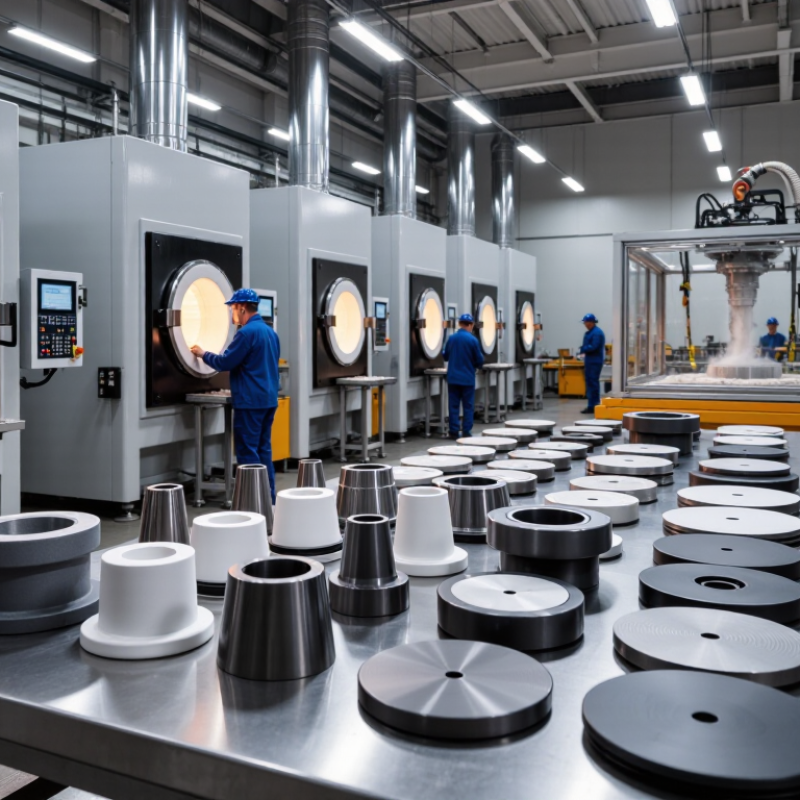
Tungsten carbide ceramic is a dense, wear-resistant material made mainly from tungsten carbide powder. It is extremely hard, yet it can fracture under sudden impact. The material often includes a small metallic binder, such as cobalt or nickel. Because of this structure, “ceramic” is not always technically precise. The term is commonly used in industrial applications.
It starts as powder. Manufacturers blend tungsten carbide with binder powder and controlled additives. Wet milling improves particle distribution and reduces large agglomerates. The mixture is then dried, granulated, and pressed into a shaped compact. Complex parts may require cold isostatic pressing or precision molding.
The compact is fragile at this stage.
Sintering follows in a vacuum or controlled atmosphere furnace. Heat removes remaining forming agents and bonds the particles into a dense body. Some producers use pressure-assisted sintering to reduce internal pores. Small pores matter. They may weaken edges and shorten service life. After cooling, diamond grinding creates accurate dimensions and smooth working surfaces.
Quality checks can include density testing, hardness measurement, dimensional inspection, and microscopic analysis.
In practical production, one challenge remains: higher hardness can reduce toughness. The best formulation depends on load, temperature, abrasion, and impact conditions, not on hardness alone.
China has become a leading tungsten carbide ceramic manufacturing hub through a dense industrial supply chain. Its strength is not limited to one factory. Powder preparation, pressing, sintering, grinding, inspection, and packaging often operate within the same regional network. This structure can shorten production cycles and reduce coordination problems.
Manufacturers commonly use advanced powder metallurgy equipment and controlled sintering furnaces. Skilled engineers adjust grain size, binder content, density, and hardness for different applications. Precision grinding can produce smooth edges and tight dimensional tolerances. Quality teams may check samples with hardness testers, microscopes, and coordinate measuring systems. Batch records also improve traceability.
Details matter.
China also offers flexible production for prototypes, small batches, and large industrial orders. Strong ports and domestic transport systems support efficient international delivery. However, quality is not automatic. Some suppliers still show uneven surface finish, unclear inspection records, or inconsistent tolerances between batches. This deserves honest attention. A careful buyer should review material certificates, inspection procedures, sample results, and production experience before ordering. Trial samples can reveal problems that polished catalog images hide. Even reliable production systems need continuous process review, especially when ceramic geometry becomes thinner or more complex.
A top tungsten carbide ceramic manufacturer in China should prove process control, not just display polished parts. The USGS Mineral Commodity Summaries 2024 reported 63,000 metric tons of tungsten content from China in 2023, around three-quarters of global mine production. This strong supply base matters, but raw-material access alone does not guarantee stable carbide performance.
Request powder-origin records, batch numbers, chemical analysis, and manufacturing flow charts. Check whether the supplier controls milling, spray drying, pressing, sintering, and grinding internally. Ask for measured hardness, density, transverse rupture strength, porosity, grain size, and dimensional tolerance. A reliable supplier should provide batch-specific certificates and allow independent testing under recognized ISO or ASTM methods. ISO 9001 certification helps, but it cannot replace production evidence. Certificates can be outdated.
Visit the factory if possible. Watch how operators handle green compacts, inspect furnaces, and record temperature curves. Examine samples under magnification for pores, edge chipping, uneven coating, or grinding burns. Request a pilot order using the same powder grade and tooling planned for mass production. Compare results across several batches, not one attractive sample. I once would have accepted a high hardness value too quickly; that was a weak judgment. Toughness, wear resistance, consistency, and service conditions must be evaluated together. A neat website proves little.
China Top Tungsten Carbide Ceramic Manufacturer?
Tungsten carbide ceramics combine extreme hardness with practical resistance to abrasion. They are commonly used in mining wear parts, cutting tools, pump seals, nozzles, and industrial dies. In harsh workshops, these components face sand, metal particles, pressure, and repeated impact every day.
Their performance comes from a dense carbide structure and carefully controlled bonding phase. Hardness helps protect surfaces from scratching and material loss. Low porosity supports longer service life. Good dimensional stability also helps maintain sealing accuracy during continuous operation. Some grades resist corrosion and heat better than others. Small pores matter.
However, hardness alone can mislead engineers. A very hard grade may chip under sudden impact. A tougher grade may wear faster in abrasive slurry. Material selection should match load, temperature, lubrication, and contact speed. Practical evaluations often include hardness testing, transverse rupture strength, porosity inspection, and dimensional checks. Surface finish deserves attention too. Poor finishing can shorten seal life, even when the material itself is excellent. This is where assumptions need checking. Test data from a laboratory may not fully represent dust, vibration, or uneven installation in the field. Reliable manufacturing therefore depends on traceable powder control, stable sintering, and consistent inspection records. Diverse applications require different solutions, not one universal grade.
China’s tungsten carbide ceramic suppliers serve demanding wear, cutting, and high-temperature applications. Choosing one requires more than comparing prices. The USGS Mineral Commodity Summaries 2024 reported about 84,000 metric tons of global tungsten mine production in 2023. China contributed roughly 80 percent. This concentration makes supply-chain verification important.
Ask for powder specifications, binder content, grain size, density, hardness, and transverse rupture strength. These values reveal more than a polished catalogue. Confirm the testing method, batch number, and calibration records. A reliable factory should provide material traceability from powder blending to final grinding. Request samples with identical dimensions and surface finishes. Check edge chipping under a microscope. Small defects can become large failures.
Tips: Audit the production line, not only the showroom. Review ISO 9001 records, inspection plans, nonconformance reports, and corrective actions. Compare three batches, not one. Also confirm tolerances using your own drawings and gauges. The International Organization for Standardization’s ISO 9001 framework supports process control, but certification alone does not prove ceramic performance. That is an easy mistake. UN Comtrade trade data can help compare export patterns, yet it cannot replace a technical audit. I would also examine packaging, lead times, and after-sales response. A low quotation may hide grinding losses, unstable dimensions, or repeated tooling costs. Suppliers should explain these risks clearly.
| Evaluation Dimension | Typical Technical Data or Benchmark | What to Verify with the Supplier | Why It Matters |
|---|---|---|---|
| Material Composition | Tungsten carbide hardmetal normally consists of WC particles bonded with cobalt or another metallic binder. Common cobalt contents are approximately 3%–20% by mass. | Request the nominal WC content, binder type, binder percentage, impurity limits, and a material certificate for each batch. | Composition directly affects hardness, toughness, corrosion resistance, density, and service life. |
| WC Grain Size | Typical categories include submicron or ultrafine grades below about 0.5 μm, fine grades around 0.5–1.0 μm, medium grades around 1–2 μm, and coarse grades above approximately 2 μm. | Check the measured grain-size distribution by metallographic analysis rather than relying only on the grade name. | Smaller grains generally improve hardness and wear resistance, while larger grains can improve fracture toughness. |
| Hardness | Many general-purpose WC–Co grades fall roughly within 86–93 HRA, depending on grain size and binder content. Vickers hardness is also commonly reported. | Confirm the test method, load, sampling location, minimum value, and hardness uniformity across the part. | Hardness is a key indicator of resistance to plastic deformation and abrasive wear. |
| Transverse Rupture Strength | Typical values vary widely, often from approximately 1,000 to above 3,000 MPa, depending on grade, porosity, grain size, and binder content. | Ask for the test standard, specimen dimensions, batch results, and statistical variation rather than a single maximum value. | This helps assess resistance to bending, impact, edge chipping, and intermittent loads. |
| Density | WC–Co hardmetal commonly has a density of approximately 13.5–15.2 g/cm³, with higher cobalt content generally lowering density. | Compare the measured density with the theoretical value for the specified composition and investigate any unexplained deviation. | Density testing can reveal composition errors, abnormal porosity, or inconsistent sintering. |
| Porosity and Structural Defects | High-quality cemented carbide should have tightly controlled porosity and no unacceptable graphite, η-phase, cracks, or large inclusions. | Request metallographic images and a porosity classification based on a recognized hardmetal inspection method. | Defects can cause premature cracking, edge failure, leakage, and unstable machining performance. |
| Dimensional Capability | Tolerance depends on geometry, size, sintering shrinkage, grinding allowance, and whether the part is supplied as-sintered or precision-ground. | Obtain a drawing review, tolerance capability study, inspection plan, and sample measurement report before mass production. | Reliable dimensional control reduces assembly problems and secondary finishing costs. |
| Surface Finish | Ground or polished carbide surfaces can achieve low roughness, but the achievable value depends on geometry, diamond tooling, and inspection equipment. | Specify Ra or another agreed surface parameter, measurement direction, equipment, and the exact functional surfaces. | Surface finish affects friction, sealing, fatigue resistance, coating adhesion, and wear. |
| Application-Based Grade Selection | Lower-binder and finer-grain grades generally favor hardness and wear resistance; higher-binder or coarser-grain grades generally favor toughness and impact resistance. | Provide operating load, speed, temperature, media, impact level, corrosion exposure, and failure history for grade recommendation. | The hardest grade is not always the best choice; application conditions determine the required balance. |
| Coating and Surface Treatment | Common coating families include titanium-based nitride, carbonitride, carbide, and aluminum-containing coatings. Performance depends on substrate and process conditions. | Confirm coating composition, thickness, adhesion, allowable edge radius, temperature limit, and post-coating dimensional change. | A coating can improve wear or oxidation resistance but may fail if the substrate or application is unsuitable. |
| Quality Management | A documented quality system should control incoming powders, mixing, pressing, sintering, grinding, inspection, nonconforming product, and traceability. | Review the quality certificate, process flow, calibration records, corrective-action procedure, and batch traceability system. | Process consistency is more important than a single impressive sample. |
| Testing and Inspection | Useful checks may include composition, density, hardness, transverse rupture strength, microstructure, dimensions, surface finish, and coating adhesion. | Agree in advance on test methods, sample quantity, acceptance criteria, inspection frequency, and report format. | Clear acceptance criteria prevent disputes and make suppliers directly comparable. |
| Prototype and Sample Approval | A representative sample should use the proposed powder grade, tooling, sintering route, grinding process, and inspection method. | Approve samples against a signed drawing and specification, then retain a reference sample for future comparison. | Production results can differ from laboratory samples if the process route changes. |
| Packaging and Export Readiness | Finished carbide components are dense and brittle; they require impact-resistant, moisture-controlled, and traceable packaging. | Confirm packaging drawings, corrosion protection where relevant, labeling, carton strength, export documents, and damage-claim procedures. | Good packaging protects precision edges and reduces transit damage. |
| Commercial and Technical Support | A capable supplier should provide engineering feedback, drawing review, tooling advice, production lead-time information, and documented corrective actions. | Evaluate response time, technical clarity, change-control discipline, warranty terms, and after-sales communication. | Responsive technical support lowers qualification risk and speeds up problem resolution. |
Note: The numerical ranges above are general industry reference ranges for cemented tungsten carbide and can vary by composition, manufacturing route, test method, and product geometry. Final acceptance values should be agreed in the technical specification and verified by documented test results.

